Importance of Doing A Tarpana Ritual by Oneself
By P.V.R. Narasimha Rao
Download this write-up as a PDF
Download Tarpana Manuals
Why Rituals
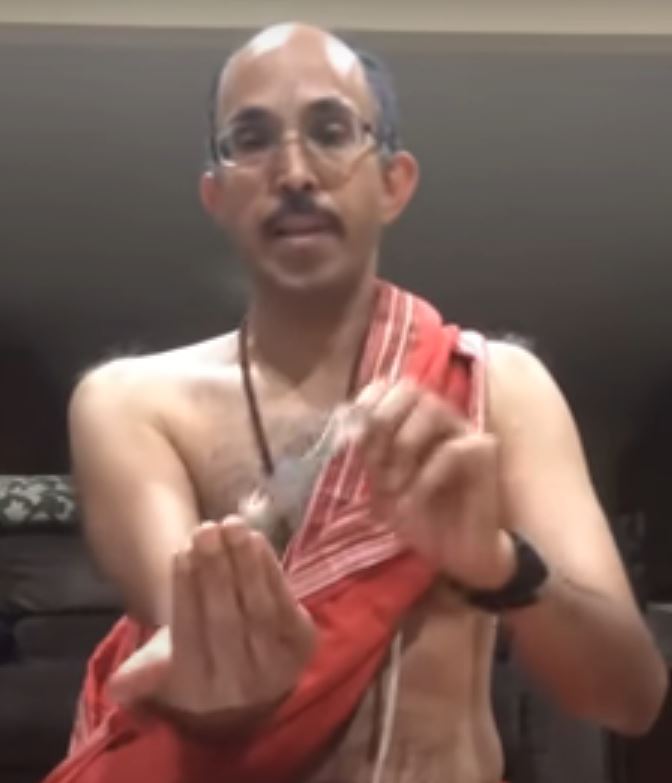
External rituals are meant to create the internal visualization needed to affect desirable internal changes in the long run. For example, one offers a full coconut into fire as poornaahuti (complete offering) at the end of a homa (fire ritual). That is symbolic of surrendering one’s head or ego (sense of I-ness) to god and burning it in the fire of wisdom and becoming free from ego. As one keeps engaging in this act again and again, the visualization becomes stronger and stronger and ego is slowly reduced.
What is Tarpana
One important ritual of Hinduism is tarpana. Tarpana means “satisfying” or “satiating”. One acknowledges the debt one has to devas (gods), rishis (sages) and pitris (ancestral manes) and tries to satisfy them using this ritual. Just as gods are invoked in fire in a homa, pitris are invoked in water in this ritual, then held in the palm and released in a specific way conducive to freeing them of some conditioning.
Importance of Tarpana
One owes a lot to one’s parents and ancestors. In modern scientific terms, one owes all of one’s genetic characteristics to one’s parents and ancestors. Each ancestor is actually present in the person as a genetic characteristic. In karmik terms, one inherits some karmas of one’s parents and ancestors and each ancestor is actually present in the person as a kaarmik predisposition. The latter approach obviously extends to multiple lives and some karmik predisposition is inherited from the ancestors from a past life too, though they may not be related to one in this life.
By thinking of the deceased ancestors with gratitude and trying to give them an emancipation, one is actually trying to free oneself from various kaarmic predispositions that one has as a result of the rina (karmik debt) with several people. One can view this as an external event of satisfying and emancipating an external entity (a pitri). Alternately, one can view this as an internal event of satisfying and releasing an internal kaarmik predisposition.
Ultimately, it is the latter. However, one needs to externalize first and perform external rituals, while thinking of what it means internally. This builds up one’s visualization and slowly brings about internal changes and eventually the desired internal change itself.
One with living parents also can perform pitri tarpanas for departed ancestors of this life and previous lives. Even if one's father does the same, one's own debts to ancestors are different from one's father's and one needs to work on those debts.
One of 2 Vital Sadhanas
Two external spiritual sadhanas are particularly powerful, useful and recommended for every person desirous of spiritual progress:
Homa (fire ritual): Gods are invoked in fire and satisfied with offerings with mantras. Please see the homa website at https://HolyFire.yoga for more. In the long run, a regular practice of this ritual increases the subtle fire burning inside one’s subtle body, burns various impediments to spiritual progress and gives clarity, focus and stability to the mind.
Tarpana (water ritual): Gods, sages and manes are invoked in water and their desires are satisfied, making their emancipation (and emancipation of one's own debts to them) easier. In the long run, a regular practice of this ritual increases the release of various kaarmik predispositions and weaknesses that are blocking one’s spiritual and material progress.
When to Perform Tarpana
Tarpana can be performed on any day. Actually, if one has time and energy, it can be performed everyday. In fact, it was part of daily rituals of Hindus not long back!
If one cannot do it daily, one can consider performing it every week or every fortnight or at least every month. One can perform this anywhere, but it may be a good idea to avoid any room where people may sleep regularly (as such places have predomant tamas). It is fine to do it in any other room of the house or the front yard or the back yard or balcony or terrace of one’s house.
Amavasya (new Moon) day or eclipse day or a Vyatipata yoga day or sankranthi (solar ingress into a tropical sign) day or pitri paksha (Krishna Pratipada to Amavasya of Bhadrapada month) are particularly good times for performing tarpana.
There are some restrictions. Tarpana with water containing sesame seeds (which is needed for pitris) should not be performed:
on a Sunday that has saptami tithi (7th day of the lunar fortnight),
on a Friday that has a nanda tithi (1st, 6th and 11th tithis of the lunar fortnights),
on a Sunday with Moon in Bharani, Krittika or Magha nakshatra, and,
on one’s birthday.
On these days, tarpanas can be performed with plain water with akshatas (raw rice grains with turmeric applied) without sesame seeds.
Frequently Asked Questions
(1) Can one with living father do Tarpana?
Some people believe that one cannot offer Tarpanas if one's father is alive. This is wrong. Suppose one is closer to one's grandfather, than one's father is. One may have a stronger connection of genes and/or mental conditioning to one's grandfather, than one's father does. In such a case, one can offer more effective Tarpana to one's grandfather, than one's father can!
Also, the nature of connections and debts of a deceased person may be different with different people. So, all of them can offer Tarpana and relieve of specific connections and debts.
This misconception stems from a rigid tradition of treating father, grandfather and great grandfather as Vasu, Aditya and Rudra and always making Tarpanas to them specifically by names. Under that rigid tradition, it makes no sense for a person whose father is alive to offer Tarpanas.
In this rigid tradition, they assume that 3 generations are always stuck in Pitri loka. When a man in the 4th generation dies, they specifically move the newly dead person to Vasu, previous Vasu to Aditya, previous Aditya to Rudra and they perform a "swargarohana" (heaven climbing) ritual for the previous Rudra.
This tradition is arbitrary. It is possible for a person to go to heaven (or even be liberated!) right away and it is possible for tens of generations to be stuck together in Pitri loka. Any tradition that assumes a rigid formula (e.g. 3 generations) is simply arbitrary.
Many of these customs and traditions are more socio-cultural constructs than Dharmik (religious) or Adhyatmik (spiritual) realities.
If one is either (a) making generic offerings to specific relations from various lives without specific names or (b) making offerings to specific dead people without compulsively including father-grandfather-great grandfather trio, then there is no need to hold back if one's father is alive.
Our website are designed such that anybody can use them, including those with father alive.
(2) Can women do tarpana?
Women's minds are equally (if not more!) influenced by thoughts and desires lingering in space, that our genetic and/or karmik connections make us susceptible to! So Tarpana that frees us from these influences is equally important for women.
In old days, men may have done spiritual sadhana for themselves and their wives, while women served them whole-heartedly. These days, there are hardly any men who do sufficient spiritual sadhana for themselves, let alone for their wives!
In fact, whenever you go to a pooja somewhere these days, you see all ladies doing pooja and chanting hymns, while men sit in the living room and gossip about gadgets, electronics, politics, films, sports etc! Women are better off offering Tarpana to their ancestors themselves.
Women have deeper devotion and higher caliber and inclination for spiritual sadhana than men these days. As a society, it a utterly foolish of us to discourage our women from doing Homa, Tarpana etc.
Moreover, chapter 8 of Garuda Purana refers to women performing Tarpana ritual.
(3) What should be done with the water and sesame seeds after ritual?
One can dispose of them at the base of a tree or plant. If that is not an option, one can dispose of in a kitchen sink or bathroom sink.
(4) Why those 3 positions of offering at the hand (mentioned in manuals for various types of tarpanas)? What is the significance of those 3 positions?
Thumb shows ego or sense of "I". Other fingers show various purusharthas (purposes fulfilled by living beings).
Ring finger, middle finger, little finger and index finger respectively show dharma (rules obeyed), artha (work accomplished), kaama (desires fulfilled) and moksha (freedom attained).
The 3 parts of each finger stand for 3 gunas. Top 1/3rd shows sattwa, middle 1/3rd shows rajas and bottom 1/3rd shows tamas. The tips of each finger shows that purushartha under the influence of the purest sattwa.
The mounts under these 4 fingers are ruled by Sun, Saturn, Mercury and Jupiter respectively.
(a) Devas (various deities) and saptarshis (7 sages whose play creates deities and worlds) engage in all purusharthas under high saattwa. To please their highly saattwik and subtle pursuit of all purusharthas, we offer water (stands for harmony) via the the tips of 4 fingers.
(b) Logical thinking and the sense of achieving something in society are shown by the mount of Mercury at the bottom of little finger. We make an offering to other sages and divinely inspired human beings (divya manushayas) via that mount. This will activate logical thinking and the sense of achievement that provokes desires (little finger) in them and leads to the good of the world. They may build temples or organizations, start movements and do such important missions in the world.
(c) The sense of moksha (liberation) arises from the intellect/wisdom. It is shown by Jupiter mount at the bottom of index finger (moksha). We make an offering to pitris (ancestral manes) via that mount and via thumb. This will activate wisdom that provokes the sense of liberation and that affects one's sense of self (thumb).
Summary: We want to activate wisdom and pursuit of liberation in ancestral manes, activate desires driven by a sense of achieving some mission in divinely inspired human beings and let deities and saptarshis do everything with the purest and clearest sattwa.
(5) I live at the beach, if I do the ritual directly at the sand, the offering can be done directly on the ground or even there we have to use a plate to colect the water oblations?
There is no issue with offering directly in the sand.
(6) At the end of the elaborate and simple procedure, we have a prayer starting with "narakeshu samasteshu..." (in all hells). What is the meaning of this prayer?
Here is the meaning of those verses at the end of procedure ("narakeshu samasteshu ... idamastu tilodakam"):
Whoever are placed in various states of suffering in various hells (undesirable and lower realms of consciousness), this water is being offering by me for their relief, welfare and gladness.
Whoever are not my relatives or my relative or my relatives in other lives, may all of them be satisfied.
Whoever were born in my lineage and stranded without someone to offer pinda and/or without wife/children, for those is given this unlimited sesame water.
From Brahma (Creator) to a blade of grass, various beings such as gods, rishis and ancestral manes, may all those be pleased, including mothers and maternal ancestors.
For forgotten zillions of lineages living in various realms of being, starting from Brahma loka to various lokas, is this sesame water.The bottomline: Though we often target specific groups of people and specific individuals for offering Tarpana, we may have very subtle and small debts to so many other beings in the cosmos, as everything is eventually connected! Thus, a good spiritual seeker will think of all beings and pray for their freedom.